Skip to content

Secugrid® Geogrid

Naue Secugrid® geogrid stabilises and reinforces roads, embankments, working platforms, slopes and walls.

  • Secugrid® is a geogrid for soil reinforcement and stabilisation, made from welded monolithic PP or PET flat bars.
  • Installed in or beneath the aggregate layer, the textured bars interlock with granular material and resist deformation under load.
  • Biaxial PP (Q1) and PET (Q6) 20/20–80/80 kN/m; uniaxial PET (R6) 40/20–400/40 kN/m.
  • CE marked for reinforcement and stabilisation (EN 13251). DIN 18200. ISO 9001.

Secugrid® is a geogrid designed for soil stabilisation and reinforcement applications. It is installed within or beneath the aggregate layer, where it enhances the stiffness of the composite system and improves load distribution. The geogrid’s rigid structure resists deformation under applied loads through interlocking, while its textured, flat bars ensure effective frictional interaction with the surrounding granular material. This limits lateral spreading of the aggregate and significantly reduces surface deformation and settlement.

Weak subsoil can lead to structural failure: roads crack, working platforms settle unevenly, and slopes lose stability under load. Secugrid® is installed within the aggregate layer above the subgrade, where it distributes loads over a wider area and reduces stress on the weak subsoil.

Secugrid® enables a significant reduction in aggregate volume, leading to lower material costs and reduced transport-related emissions. In typical road applications, aggregate savings of 30–40% can be achieved. This not only decreases the overall carbon footprint of the project but also contributes to a more economical construction process.

Secugrid® delivers high radial stiffness at 0.5% strain: up to 1,008 kN/m for the Secugrid® 80/80 Q1 grade. This high stiffness at low strain is a key engineering parameter to reduce deformation in soil. In practical applications, geogrids do not reach their ultimate tensile strength. Instead, their performance is governed by behaviour within a low-strain range of approximately 0.5 to 2%. Secugrid® is specifically engineered to provide optimal stiffness within this critical strain range.

Secugrid® geogrid functions:

  • Stabilisation

    Stabilisation

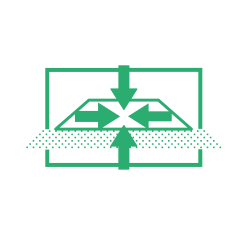
    Secugrid® provides confinement and/or interlock, thereby enhancing load distribution and reducing deformation.

  • Reinforcement

    Reinforcement

    Secugrid® absorbs tensile forces within the aggregate layer, thereby enhancing strength, stiffness, and load-bearing.

Secugrid® geogrid advantages: three reasons to specify it

  • Strong road

    Early strength mobilisation reduces rutting

    Secugrid® mobilises its design strength at very low strain, helping distribute loads effectively before significant ground deformation occurs. This reduces rutting and can lower aggregate consumption.

  • Load distribution

    Stable load transfer across the whole area

    The monolithic design ensures excellent robustness, load transfer and high junction efficiency of the welded bars, maintaining stiffness under load. This enhances aggregate interlock, improves confinement, and delivers reliable long-term performance.

  • Roll

    Easy handling and fast installation

    4.75 m × 100 m rolls reduce overlaps, speed up installation and help lower waste and labour costs. Printed roll identification supports reliable on-site quality control.

Application areas

Roads without bound surface layers are the most common application. On soft subgrade soils, conventional aggregate layers are prone to rapid deformations under repeated loading. Installed within or beneath the base course Secugrid® enhances stability and load distribution, enabling a reduction in aggregate thickness of around 30% compared with unreinforced sections.

Close-up of crushed rocks and soil resting on a Secugrid® geogrid reinforcement mesh

To the application:

Embankments on soft ground, along with steep slopes and reinforced soil walls, are key applications for Secugrid® R6 and Q6 PET grades. Their long-term design strength (TD) is determined in accordance with EBGEO and BS 8006, ensuring reliable performance in permanent structures.

Secugrid® systems enable slope and wall inclinations from 45° up to vertical (90°), offering compatibility with a wide range of facing solutions.

  • Construction platforms and crane pads

    • Base course reinforcement for tracked and wheeled plant
    • Load distribution beneath crane outriggers pads
    • Reduced differential settlement under heavy loads
  • Railway construction

    • Sub-ballast reinforcement and track rehabilitation
    • Subgrade improvement for new construction and maintenance

  • Mining

    • Mining haul roads on weak subgrades
    • TSF access roads
  • Wind and solar farm roads and crane pads

    • Base course reinforcement under paved areas
    • Utility trench stabilisation
    • Reinforced unpaved parking and logistics areas

Technical properties

PropertyUnit20/20 Q130/30 Q140/40 Q160/60 Q180/80 Q1
Product build-up
Raw material—PPPPPPPPPP
Geogrid—Stretched, monolithic, textured flat bars with welded junctionsStretched, monolithic, textured flat bars with welded junctionsStretched, monolithic, textured flat bars with welded junctionsStretched, monolithic, textured flat bars with welded junctionsStretched, monolithic, textured flat bars with welded junctions
Mechanical properties
Nominal tensile strength, md / cmdkN/m≥ 20 / ≥ 20≥ 30 / ≥ 30≥ 40 / ≥ 40≥ 60 / ≥ 60≥ 80 / ≥ 80
Tensile strength at 2 % strain, md / cmdkN/m8 / 812 / 1216 / 1622 / 2225 / 25
Elongation at nominal tensile strength, md / cmd%≤ 7 / ≤ 7≤ 7 / ≤ 7≤ 7 / ≤ 7≤ 7 / ≤ 7≤ 7 / ≤ 7
Tensile stiffness J₀%–1%,k0 acc. to EBGEO, md / cmdkN/m400 / 400600 / 600800 / 8001,200 / 1,2001,600 / 1,600
Radial stiffness at 0.5 % elongationkN/m≥ 334≥ 418≥ 440≥ 458≥ 1,008
Radial stiffness at 2.0 % elongationkN/m≥ 264≥ 326≥ 405≥ 507≥ 715
Cyclic tensile modulus at 0.5 % strain, md / cmdkN/m—1,000 / 1,0001,300 / 1,300——
Construction related strain%00000
Interaction
Geogrid surface friction at 20 kPa normal stresskPa≥ 11.4≥ 11.4≥ 11.4≥ 11.4≥ 11.4
Geogrid surface friction at 40 kPa normal stresskPa≥ 19.7≥ 19.7≥ 19.7≥ 19.7≥ 19.7
Geogrid surface friction at 60 kPa normal stresskPa≥ 26.2≥ 26.2≥ 26.2≥ 26.2≥ 26.2
Delivery form, durability and certification
Roll dimensions, width x lengthm4.75 x 1004.75 x 1004.75 x 1004.75 x 1004.75 x 100
Product name printed on product, max. distancem5.05.05.05.05.0
Durability (Annex B), natural soils pH 4–9, soil temperature < 25 °Cyears≥ 100≥ 100≥ 100≥ 100≥ 100
Close-up of aggregate interlocking with the white Naue Secugrid® geogrid.

Why low-strain stiffness matters more than ultimate tensile strength

Very often geogrid performance is defined in terms of ultimate tensile strength. In pavement design and working platform applications, however, geogrids operate at low strain levels, typically below 2%. Under these conditions, stiffness is the governing parameter, not ultimate strength.


Secugrid® is engineered to provide high biaxial and radial secant stiffness at strains of 0.5% and 2.0%. As a result, the geogrid mobilizes tensile forces at an early stage, before significant deformation occurs in the aggregate layer. This early load transfer mechanism effectively reduces rutting and contributes to an extended service life of infrastructure projects.

PET Q6 grades provide significantly higher radial tensile stiffness, driven by the superior stiffness properties of polyester compared to polypropylene. Secugrid® 80/80 Q6, for instance, reaches ≥ 1,236 kN/m at just 0.5% strain.

Furthermore, Secugrid® PET Q6 and R6 geogrids exhibit excellent creep resistance, making them the preferred choice for permanent and long-term geotechnical structures.

Naue Portal - the free digital platform for geotechnical engineers.

Naue Portal: your all-in-one free geotechnical software solution for planning and cost estimation

  • One platform – multiple solutions: access a wide range of geotechnical design tools in a single portal.
  • User-friendly and accessible: available anytime, anywhere via desktop or mobile.
  • Optimised cost and material usage: reduce construction costs while ensuring long-term project stability.
  • Compliant with industry standards: aligns with AASHTO, and other engineering guidelines.

Frequently asked questions

Secugrid® is a geogrid for soil reinforcement and stabilisation, installed within or beneath aggregate layers. Its textured flat bars interlock with the granular fill, restraining lateral movement under load. This improves load distribution, increases bearing capacity, and reduces settlement and rutting. Secugrid® is made from stretched PP or PET flat bars with welded junctions.

Pricing for Secugrid® varies depending on quantity, delivery location, and market conditions. For a tailored project quotation please contact Naue via the button below.

Note: Reinforced solutions typically offer lower total installed costs compared to unreinforced designs, thanks to reduced aggregate consumption and faster installation. Use the Naue Portal to estimate your potential savings.

Q1 (PP, biaxial)

Cost-effective solution for road stabilisation and working platforms. Provides equal strength in machine direction (MD) and cross-machine direction (CMD), ensuring uniform load distribution.

Q6 (PET, biaxial)

Offers lower creep and higher long-term design strength (TD), determined in accordance with EBGEO and BS 8006. Recommended where long-term performance is critical or where TD is specified.

R6 (PET, uniaxial)

Designed for applications with a defined primary load direction, such as embankments, reinforced soil structures, and load transfer platforms. Provides high strength and stiffness in one direction.

In road and working platform applications, geogrids typically operate at strain levels below 2%, meaning ultimate tensile strength is rarely mobilised. Instead, stiffness at low strains - particularly at 0.5% and 2.0% - governs performance.

These stiffness values determine how quickly the geogrid mobilises load. Higher stiffness enables earlier load transfer, resulting in reduced deformation.

What certifications does Secugrid® hold?

CE marking for reinforcement and stabilisation (EN 13251/EAD). All grades: DIN 18200 conformity assessment. ISO 9001 quality management.

High resistance to installation damage, even under harsh conditions. Comparative testing (EN ISO 10722) with crushed granite showed zero broken ribs.

The installation damage reduction factor (RFID) ranges from 1.10 to 1.46, depending on the fill material. Textured PP flat bars provide inherent durability and resist damage during placement, eliminating the need for additional protective layers.

All grades: 4.75 m wide x 100 m long (475 m² per roll). Applies to PP Q1, PET Q6 and PET R6 (up to 200 kN/m) variants. Wide rolls reduce overlaps on large flat areas. Product identification printed at max. 5.0 m intervals.

Secugrid® supports design in accordance with major international standards, including:

  • Eurocode 7 (Europe)
  • EBGEO (Germany)
  • BS 8006 (UK)

Yes. Naue provides comprehensive design support, design review and specification assistance. The Naue Portal design calculators determine the required geogrid grade, layer thickness, and potential cost and material savings for your project in many different applications. Naue’s engineering & design department (EDD) also provides project-specific design assistance on request. Contact Naue via the button below.

Let’s discuss your project!

Please use the form to tell us about your enquiry
(* = required field)