Skip to content

Combigrid® Geocomposite

Naue Combigrid® is a geogrid with integrated nonwoven geotextile that combines stabilisation, reinforcement, separation and filtration in a single installation step.

  • Combigrid® makes weak ground strong enough to build on. It strengthens the soil, keeps layers separated and lets water drain through.
  • Combigrid® combines a Secugrid® geogrid permanently bonded with a Secutex® nonwoven in one product.
  • Over 100,000 load passes with no critical deformation (75 mm rut); Traffic Benefit Ratio > 2,270 (unreinforced ground fails after ~20 passes).
  • CE (EU), BBA (UK), ISO 9001, DIN 18200, EPD, ASTM D7556 - full list in technical data.

Combigrid® is a composite of a Secugrid® geogrid and a Secutex® nonwoven geotextile, permanently bonded into one product. It delivers four certified functions: reinforcement, stabilisation, separation and filtration.

Installed between weak subgrade and base course prior to aggregate placement, the geogrid provides structural reinforcement, while the integrated nonwoven ensures long-term separation of soil and aggregate and allows efficient water flow.

Soft ground is one of the most common challenges in construction - and one of the costliest. When the soil beneath a road, platform or storage area is too weak, trucks create extreme rutting, surfaces crack, and projects are delayed.

The conventional solution is straightforward but expensive: import additional fill material. On some sites, this can mean hundreds of truckloads. Combigrid® addresses this problem directly.

For those managing budgets or resource-efficient targets, every cubic metre of aggregate saved reduces quarrying and transport. Combigrid® is backed by an independently verified Environmental Product Declaration (EPD), providing transparent data for use in green building certification systems (like e.g. BREEAM (UK), LEED (USA) or DGNB (Germany).

Combigrid® is a geocomposite that firmly bonds a Secugrid® geogrid to a needle-punched Secutex® nonwoven geotextile. It is specifically designed for very weak subsoils with CBR values below 3% and has been installed on hundreds of millions of square metres worldwide.

The product is designed for a service life of 120 years, with durability certified for 100 years or more.

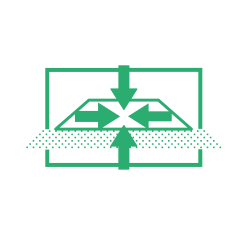
Combigrid® geocomposite functions:

  • Stabilisation

    Stabilisation

    Locks the aggregate in place. Maintaining a firm and even surface, even after thousands of load cycles.

  • Reinforcement

    Reinforcement

    Enhancing strength, stiffness, and load-bearing by mobilisation of tensile forces.

  • Separation

    Separation

    Maintains permanent separation between subsoil and aggregate. Without this function, fine particles migrate into the aggregate layer, reducing its load-bearing capacity.

  • Filtration

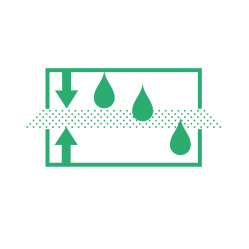
    Filtration

    Allows water to pass through while retaining fine particles. This prevents the “pumping” effect that can lead to progressive failure of the road structure from below.

Combigrid® geocomposite advantages: reduce material and time on site

  • Roll

    One installation step

    Everything is delivered in a single roll (4.75 m wide, 100 m long). No need to order, transport or install a second product.

  • Costs

    Less aggregate

    Due to the reduced thickness of the aggregate layer, projects generally require 20 to 50 % less fill material compared to unreinforced constructions.

  • Function duration

    Extended service life

    Combigrid® demonstrated significantly higher Traffic Benefit Ratios (TBR) compared to unreinforced sections. It can withstand substantially more traffic, leading to lower maintenance.

  • Certificate

    Internationally certified

    CE marked in the EU (stabilisation and reinforcement), BBA certified (UK), ISO 9001, DIN 18200, EPD verified. Durability: 100 years or more.

Application areas

Unbound roads are among the most common applications for this geogrid–nonwoven geotextile composite in road construction, including temporary haul roads, construction access roads, and rural roads. On soft subgrades, conventional aggregate layers deform quickly under repeated loading. Without an effective separation layer, fine particles migrate from the subgrade into the base course, reducing its stiffness and performance.

Combigrid® is installed between the subgrade and the base course, combining reinforcement, stabilisation, separation, and filtration in a single layer. On a typical 10,000 m² haul road, replacing two separate products with one eliminates an entire installation step, reducing installation time by approximately 30 - 40%.

Advantages:

  • Reduced surface deformation: Rut depths < 75 mm even after 100,000 load cycles (TBR > 2,270)
  • Reduced base course thickness: Typically, 20 - 50% reduction compared to unreinforced sections
  • Lower maintenance demand: Fewer maintenance cycles and extended service life
  • Easy deconstruction: Aggregate remains clean and can be recovered at end of service life

Working platforms provide a stable operating surface for piling rigs, cranes, and other heavy equipment. These platforms are often constructed on soft subgrades with insufficient load-bearing capacity. Combigrid® stabilises the base course, improves bearing capacity, and reduces settlement under load. The integrated nonwoven geotextile ensures separation and filtration, eliminating the risk of omitting a separate layer during installation.

Advantages:

  • Increased bearing capacity on soft subgrades: Up to 50% reduction in required fill compared to unreinforced platforms
  • Reduced differential settlement: Improved load distribution under heavy equipment
  • Cost-efficient solution: Alternative to deep foundations or ground improvement methods such as piling or soil stabilisation
  • Easy decommissioning: Clean removal with full recovery and reuse of aggregate material
Heavy-duty mobile crane on a Combigrid®-stabilised crane platform supporting wind turbine construction.

To the application:

  • Paved roads

    • Sub-base reinforcement and stabilisation for highly-trafficed roads
    • Improved load transfer on variable subsoils
  • Storage areas

    • Sub-base reinforcement and stabilisation of logistics platforms, container yards
    • Recycled (RC) aggregate base courses
  • Railway construction

    • Reinforcement of sub-ballast and ballast layers
    • Prevention of subgrade pumping
    • Reduction of track maintenance requirements
  • Landfill engineering

    • Access roads for landfill base
    • Landfill capping systems
  • Mining

    • Tailings storage facilities (TSF)
    • Stable (temporary) access and haul roads
    • Reinforcement of working platforms
  • Energy infrastructure

    • Access roads for solar, wind, and hydropower projects
    • Base course improvement for onshore wind and solar plants
    • Construction of pipeline corridors

Technical properties

PropertyUnit20/20 Q1 GRK 4 C30/30 Q1 GRK 4 C40/40 Q1 GRK 4 C60/60 Q1 GRK 4 C
Product build-up
Raw material—PPPPPPPP
Geogrid—Stretched, monolithic, textured flat bars with welded junctionsStretched, monolithic, textured flat bars with welded junctionsStretched, monolithic, textured flat bars with welded junctionsStretched, monolithic, textured flat bars with welded junctions
Filter geotextile—Mechanically bonded, welded within the geogrid structureMechanically bonded, welded within the geogrid structureMechanically bonded, welded within the geogrid structureMechanically bonded, welded within the geogrid structure
Polymer coating—Not permittedNot permittedNot permittedNot permitted
Mechanical properties
Nominal tensile strength, md / cmdkN/m≥ 20 / ≥ 20≥ 30 / ≥ 30≥ 40 / ≥ 40≥ 60 / ≥ 60
Tensile strength at 2 % strain, md / cmdkN/m8 / 812 / 1216 / 1622 / 22
Elongation at nominal tensile strength, md / cmd%≤ 7 / ≤ 7≤ 7 / ≤ 7≤ 7 / ≤ 7≤ 7 / ≤ 7
Tensile stiffness J₀%–1%,k0 acc. to EBGEO, md / cmdkN/m400 / 400600 / 600800 / 8001,200 / 1,200
Radial stiffness at 0.5 % elongationkN/m≥ 334≥ 418≥ 440≥ 458
Radial stiffness at 2.0 % elongationkN/m≥ 264≥ 326≥ 405≥ 507
Cyclic tensile modulus at 0.5 % strain, md / cmdkN/m—1,000 / 1,0001,300 / 1,300—
Construction related strain%0000
Interaction and classification
Geogrid surface friction at 20 kPa normal stresskPa≥ 11.4≥ 11.4≥ 11.4≥ 11.4
Geogrid surface friction at 40 kPa normal stresskPa≥ 19.7≥ 19.7≥ 19.7≥ 19.7
Geogrid surface friction at 60 kPa normal stresskPa≥ 26.2≥ 26.2≥ 26.2≥ 26.2
Geotextile robustness class of the complete product (expert verification required)—GRK 4GRK 4GRK 4GRK 4
Delivery form, durability and certification
Roll dimensions, width x lengthm4.75 x 1004.75 x 1004.75 x 1004.75 x 100
Product name printed on product, max. distancem5.05.05.05.0
Durability (DoP Annex B), natural soils pH 4–9, soil temperature < 25 °Cyears≥ 100≥ 100≥ 100≥ 100
CE marking—Reinforcement and stabilisationReinforcement and stabilisationReinforcement and stabilisationReinforcement and stabilisation
Further certification—DIN 18200, EN ISO 9001, IVG certificate, product group EPDDIN 18200, EN ISO 9001, IVG certificate, product group EPDDIN 18200, EN ISO 9001, IVG certificate, product group EPDDIN 18200, EN ISO 9001, IVG certificate, product group EPD
Exemplary comparison of a geogrid alone and Naue Combigrid® with integrated nonwoven geotextile beneath aggregate on weak subsoil.
Exemplary illustration: A geogrid alone may allow fine soil particles to migrate into the aggregate. Naue Combigrid® combines reinforcement with an integrated nonwoven geotextile for additional separation and filtration.

Geogrid with nonwoven geotextile vs. geogrid alone on weak subsoils

A geogrid with nonwoven performs fundamentally differently from a standalone geogrid on weak subsoils - a distinction that matters for correct specification below CBR 3 %.

Above CBR 3 %, a standard geogrid may be sufficient: it interlocks with the aggregate and distributes loads. Below 3 %, it is no longer adequate:

  1. Soft subgrade migrates upward through the apertures into the base course ("pumping" or fines intrusion).
  2. Accumulated fines reduce internal shear strength and prevent effective aggregate interlock.
  3. The base course loses stiffness; rut depth increases with each load cycle.
  4. The contaminated base behaves almost like unreinforced fill - the geogrid stays intact, the aggregate around it does not.

Hence the standard practice of adding a separate geotextile. Combigrid® makes that second layer unnecessary: a Secutex® nonwoven is permanently bonded between the reinforcement bars, its 3-D fibre matrix (O90 = 0.12 mm) filtering without clogging even under sustained dynamic loading. Fines intrusion is prevented and water drains freely.

Naue Portal - the free digital platform for geotechnical engineers.

Naue Portal: your all-in-one free geotechnical software solution for planning and cost estimation

  • One platform – multiple solutions: access a wide range of geotechnical design tools in a single portal.
  • User-friendly and accessible: available anytime, anywhere via desktop or mobile.
  • Optimised cost and material usage: reduce construction costs while ensuring long-term project stability.
  • Compliant with industry standards: aligns with AASHTO, and other engineering guidelines.

Frequently asked questions

Combigrid® is a geogrid–nonwoven composite that combines four functions: reinforcement, stabilisation, separation, and filtration. It consists of a high-strength Secugrid® geogrid integrally bonded to a needle-punched Secutex® nonwoven geotextile. Installed between weak subgrade and base course, it reinforces the soil, stabilises the aggregate layer, prevents intermixing of fine subgrade particles with the base course, and maintains water permeability for effective drainage.

Pricing is project-specific and depends on factors such as quantity, selected grade, and delivery location. However, overall project savings are typically significant: sub-base thickness reductions of 20 – 50% compared to unreinforced designs are common. For accurate pricing, contact Naue via the contact form below for a project-specific quotation.

Secugrid® is a standalone geogrid designed for reinforcement and stabilisation, typically used on subgrades with CBR values above 3%. Combigrid® combines this reinforcement function with an integrated Secutex® nonwoven geotextile, providing additional separation and filtration. Combigrid® is therefore specified for very soft subgrades (CBR < 3%) or in applications where both a geogrid and a geotextile would otherwise be required.

PP (Q1, GRK 4C): Tensile strengths from 20/20 to 60/60 kN/m. Standard solution for most infrastructure applications, compliant with German GRK robustness class requirements.

PET (Q6 R156 C): Tensile strengths from 30/30 to 80/80 kN/m. Includes verified long-term design strength (TD) in accordance with EBGEO and approvals such as BBA/HAPAS. Maximum creep strain ≤ 0.50%. Typically specified for permanent and heavily loaded structures.

Documented reductions in sub-base thickness typically range from 20 - 50% compared to unreinforced designs. Project examples include:

  • Espelkamp (Germany): 140 truckloads of fill eliminated and a 25 cm reduction in sub-base thickness, resulting in savings of approximately €10,000
  • Blenheim Lake Restoration (UK): 20% reduction in aggregate use
  • Redlands Farm Solar Park (UK, 2014): 30% aggregate saving

CO₂ savings are directly linked to the reduced material volume and transport requirements and therefore vary by project. Verified life-cycle assessment data is available in the Environmental Product Declaration (EPD).

Yes. After decommissioning of a haul road or working platform, Combigrid® can be removed cleanly. The integrated nonwoven geotextile maintains effective separation between aggregate and subgrade, allowing the aggregate to be recovered with minimal contamination. For example, at Dogger Bank Wind Farm (UK), the recovered aggregate was washed and successfully resold to local suppliers.

Combigrid® is supported by a comprehensive set of certifications and verified performance documentation:

  • CE marking for stabilisation in accordance with the relevant European Technical Assessment (ETA)
  • CE marking for reinforcement based on Harmonised European Standard (hEN)
  • BBA certification (e.g. certificate no. 14/H218 for applicable grades) for use in the UK
  • ISO 9001 certified quality management system
  • Assessment of conformity in accordance with DIN 18200
  • Environmental Product Declaration (EPD) providing verified life-cycle data for sustainability assessments
  • Performance testing including cyclic behaviour (e.g. ASTM D7556)

Yes. The EPD provides verified life-cycle assessment data covering raw material extraction, manufacturing and end-of-life. Essential for BREEAM, LEED, DGNB. For EU public-sector tenders, EPD availability is increasingly mandatory.

Combigrid® complies with GRK 4C. It can be installed in all weather conditions, including rain and on wet subsoils.

Combigrid® is designed for high installation robustness, even under demanding site conditions with coarse and angular aggregates. Robustness is verified through standardised installation damage testing, like e.g. EN ISO 10722.

All grades: 4.75 m width x 100 m length (475 m² per roll, approx. 180 kg). Exception: the DB/HPQ variant for Deutsche Bahn railway projects is supplied in 4.75 m x 50 m rolls.

Primary test standard: EN ISO 10319 (tensile strength). Installation damage: EN ISO 10722. Creep: EN ISO 13431. Cyclic tensile modulus: ASTM D7556. Design standards: Eurocode 7 (Europe), EBGEO (Germany), BS 8006 (UK), AASHTO (North America). Quality: ISO 9001, DIN 18200.

Designed for weak subsoils with CBR below 3 %. Also specified on stronger subsoils where separation and filtration are needed, e.g. recycled aggregate base courses or railway rehabilitation.

Yes. Naue offers comprehensive design support for Combigrid® applications, including grade selection, design optimisation, and specification assistance. Using tools such as the Naue Platform, Naue Paved & UnPavedRoad design calculators in the Naue Portal, engineers can determine required layer thicknesses, appropriate product grades, and potential cost savings based on established methods (e.g. BR470, AASHTO ‘93).

Naue’s engineering team also provides project-specific assessments and designs on request, ensuring technically sound and economical solutions tailored to site conditions. Get in touch via e-mail to info@naue.com or using the project request form below.

Let’s discuss your project!

Please use the form to tell us about your enquiry
(* = required field)