





Skip to content

Bentofix® Geosynthetic clay liner

Naue Bentofix® is a geosynthetic clay liner (GCL) for waterproofing in landfill engineering, groundwater protection and hydraulic applications.

  • Bentofix® is a geosynthetic clay liner (GCL): sodium bentonite needle-punched between two PP geotextiles.
  • On hydration the bentonite swells into a hydraulic barrier. Sealing equivalent to a 40 cm compacted clay liner.
  • Six grades, from NSP 4000 to the PE-laminated X-series (X2/X5F BFG 5300) - full range in technical data.
  • CE (EN 13491), BBA-HAPAS (no. 05/4256), LAGA, ISO 9001, DBS 918 039 HPQ - full list in technical data.

Bentofix® is a geosynthetic clay liner for waterproofing and containment. It combines sodium bentonite powder with two PP geotextile layers. When hydrated, the bentonite swells and forms a reliable hydraulic barrier.

Conventional clay liners are 400 mm thick. They require excavation, selected fill and compaction. They cannot self-repair after damage or differential settlement. A geosynthetic clay liner replaces this with a 10 mm composite. Bentofix® delivers equivalent sealing performance. Result: faster installation, less excavation and lower cost.

Bentofix® replaces a 400 mm clay liner with a 10 mm sheet. Excavation volumes fall. Landfill airspace is preserved. One product covers five application categories. CO₂ footprint: 6.81 kg CO₂-eq/m². Naue provides full system specification at no charge.

BFG 5000 achieves k = 1.0 x 10⁻¹¹ m/s (EN 16416 / ASTM D5887). X2 and X5F BFG 5300 achieve k ≤ 1.0 x 10⁻¹⁴ m/s for the PE layer (EN 14150, calculated). Both meet or exceed 40 cm compacted clay. CE marking per EN 13491. BBA-HAPAS certificate no. 05/4256 covers BFG 5000 and X2 BFG 5300. NSP 4900 holds LAGA approval for landfill capping. NSP 4000, NSP 4900 and BFG 5000 hold IVG certificates. Thermal Lock delivers directionally independent shear strength: over 2,000,000 fibres/m².

Bentofix® geosynthetic clay liner functions:

  • Barrier

    Barrier

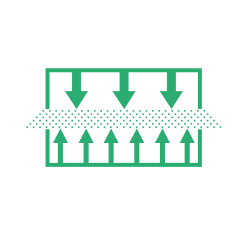
    Sodium bentonite swells on hydration. Forms a hydraulic barrier at k = 1.0 x 10⁻¹¹ m/s (BFG 5000, EN 16416).

  • Separation

    Separation

    The PP nonwoven geotextile layers separate the bentonite core from subgrade and cover materials. Prevents intermixing throughout service life.

Bentofix® advantages: why engineers specify this geosynthetic clay liner

Bentofix® delivers certified sealing performance in 10 mm installed thickness. Five engineered advantages make it the preferred GCL for landfill, infrastructure and water containment projects.

  • Safety

    Self-sealing and self-healing

    Sodium bentonite re-seals after punctures, settlement and desiccation. No patching required. Lower maintenance cost over product life.

  • Reduced thickness

    Only 10 mm installed thickness

    Replaces 400 mm compacted clay liner. Reduces excavation volume and preserves landfill airspace. Faster programme and lower material cost.

  • Thermal insulation

    Thermal Lock: uniform shear strength

    Over 2,000,000 fibres/m² uniformly needle-punched and thermally anchored. Directionally independent shear strength. Enables slopes of 2.5:1 or steeper with confidence.

  • Certificate

    Globally certified

    CE marking per EN 13491. ISO 9001 quality management. BBA-HAPAS cert. no. 05/4256 (BFG 5000, X2 BFG 5300). LAGA approval (NSP 4900). IVG certificate (NSP 4000, NSP 4900, BFG 5000). WHG-compliant. DBS 918 039 HPQ (NSP 5400 DB, railway).

  • Costs

    Quick and cost-effective installation

    5.0 m wide rolls (standard grades). 30 cm colour-coded overlap guide on product. BFG 5000 all-direction self-sealing overlaps reduce seaming. EPD published for BREEAM/LEED reporting.

Application areas

Typical applications:

  • Landfill base liners in single and composite lining systems
  • Landfill capping and final closure systems
  • Leachate containment beneath engineered fill
  • Gas and vapour seals in landfill covers (Bentofix® X variants)

Bentofix® is the specified geosynthetic clay liner for landfill base and capping applications where leachate containment and gas control are required. The Thermal Lock shear strength enables steep slope liner installations in lined waste cells. Bentofix® BFG 5000 all-direction self-sealing overlaps reduce seaming risk in complex geometries. NSP 4900 holds LAGA approval for landfill capping class I and II. CE marking per EN 13491 confirms declared hydraulic performance.

Advantages in landfill applications:

  • 10 mm GCL preserves maximum landfill airspace vs 400 mm CCL
  • Self-healing tolerates differential settlement under fill loads
  • BFG 5000: all-direction self-sealing overlaps for lining complex geometries
  • Bentofix® X2/X5F: gas and ion exchange protection for aggressive leachate environments
  • NSP 4900: LAGA approval for landfill capping class I and class II (Germany)
Photo showing the installation/laying of Bentofix® geosynthetic clay liner at a landfill construction site.

To the application:

Typical applications:

  • Environmental protection liners under roads (RiStWag)
  • Protection under motorways, railways and airports (M TS E)
  • Retention basins and stormwater attenuation ponds
  • Secondary containment for fuel and chemical storage facilities

Bentofix® geosynthetic clay liner is the engineered barrier for groundwater protection in infrastructure applications. The NSP 5400 DB holds HPQ designation under DBS 918 039 for Deutsche Bahn railway earthworks (Application 3.11, TM 4-2015-10838 I.NPF 2 of 10.11.2015). Self-healing is critical for infrastructure projects with post-construction settlement risk. WHG-compliant systems meet German water law requirements for roads and motorways.

Advantages in groundwater protection:

  • NSP 5400 DB: only GCL with HPQ designation for DB Application 3.11
  • WHG-compliant: meets RiStWag and M TS E requirements for German roads
  • 10 mm profile reduces pavement reconstruction depth
  • 5.0 m wide rolls cover large infrastructure areas with minimal seaming
Photo of a construction site where Naue Bentofix® is installed for groundwater protection.

To the application:

Technical properties

PropertyUnitBFG 5000NSP 4000NSP 4900
Cover layer
Geotextile type—Needle-punched nonwoven PPNeedle-punched nonwoven PPNeedle-punched nonwoven PP
Mass per unit areag/m²300220≥ 200
Bentonite filling of cover NWg/m²800 (entire surface)800 (50 cm at each length edge)800 (50 cm at each length edge)
Bentonite layer
Bentonite type—Sodium bentonite powderSodium bentonite powderSodium bentonite powder
Bentonite grain sizemm≤ 0.2≤ 0.2≤ 0.2
Mass per unit area (at ≤ 15 % moisture content)g/m²5,000 (incl. cover NW filling)3,6704,670
Swell indexml/2 g≥ 24≥ 24≥ 24
Fluid lossml/2 g≤ 18≤ 18≤ 18
Moisture content%1010≤ 15
Carrier layer
Geotextile type—Slit-film woven PPSlit-film woven PPSlit-film woven PP
Mass per unit areag/m²200110≥ 100
Geosynthetic clay liner
Mass per unit area (at ≤ 15 % moisture content)g/m²5,5004,0005,000
Thickness, drymm7.06.06.0
Tensile strength, max., MDkN/m2013.013.0
Tensile strength, max., CMDkN/m1113.013.0
Elongation at maximum tensile force, MD%81010
Elongation at maximum tensile force, CMD%466
Peel strength, maximum peak valueN/10 cm≥ 60≥ 60≥ 60
Peel strength, average valueN/m≥ 360≥ 360≥ 360
Internal shear strength (24 h hydration, 20 kPa)kPa≥ 35≥ 35≥ 35
Static puncture test (CBR)N2,5002,2002,200
Permeability k₁₀m/s1.0 · 10⁻¹¹1.2 · 10⁻¹¹1.2 · 10⁻¹¹
Permittivity ψ₁₀1/s1.5 · 10⁻⁹2.5 · 10⁻⁹1.7 · 10⁻⁹
Index flux q₁₀(m³/m²)/s2.2 · 10⁻⁹3.5 · 10⁻⁹2.6 · 10⁻⁹
Overlaps, quality assurance and delivery form
Overlapping areas, self-sealing—Longitudinal and transverseLongitudinalLongitudinal
Needle detector tested—YesYesYes
Fibre bond thermally treated on carrier side—YesYesYes
Roll widthm5.05.05.0
Roll lengthm405050
CO₂-eq, cradle to grave (A1–C4)kg CO₂-eq/m²6.436.436.43
Split-view illustration of a roadside stormwater retention basin comparing a compacted clay liner with a Bentofix® geosynthetic clay liner. The left side shows a multi-layer compacted clay barrier, while the right side shows a thin Bentofix® liner beneath the cover soil. Both basins have the same water level, illustrating the reduced liner thickness of the geosynthetic solution.
Comparison of a conventional compacted clay liner on the left and a Bentofix® geosynthetic clay liner on the right in a roadside stormwater retention basin. The illustration highlights the significantly reduced barrier thickness of the geosynthetic solution while maintaining the same storage volume.

Bentofix® geosynthetic clay liner vs compacted clay liner

Specifying engineers frequently ask whether a geosynthetic clay liner (GCL) delivers equivalent containment performance to a compacted clay liner (CCL). The confirmed answer, per EN 13491 declaration and RTF source data, is yes.

A compacted clay liner requires 400 mm of selected clay material compacted to achieve k = 1 x 10⁻⁹ m/s. Site-specific testing is mandatory. Borrow pits must be opened and closed. Compaction requires specialist plant and quality assurance testing at every lift. On slopes, compaction becomes unreliable.

Bentofix® BFG 5000 achieves k = 1.0 x 10⁻¹¹ m/s (EN 16416 / ASTM D5887). Bentofix® X2 and X5F BFG 5300 achieve k ≤ 1.0 x 10⁻¹⁴ m/s for the PE layer (EN 14150, calculated). Both values are one to three orders of magnitude lower than the typical CCL specification. Installed thickness is 10 mm hydrated.

The Thermal Lock process needle-punches over 2,000,000 fibres/m² uniformly through the bentonite layer and thermally anchors them to the carrier geotextile. This provides directionally independent shear strength, enabling installations on slopes of 2.5:1 or steeper, where CCL compaction fails.

Self-healing is the critical additional benefit. CCLs crack on desiccation. Bentofix® re-seals on re-hydration. Sites with differential settlement risk, wetting-drying cycles or root penetration risk require this property. The Bentofix® X variants additionally provide a polyethylene barrier, improving desiccation resistance and protecting against ion exchange in chemically aggressive leachates.

Naue Portal - the free digital platform for geotechnical engineers.

Naue Portal: your all-in-one free geotechnical software solution for planning and cost estimation

  • One platform – multiple solutions: access a wide range of geotechnical design tools in a single portal.
  • User-friendly and accessible: available anytime, anywhere via desktop or mobile.
  • Optimised cost and material usage: reduce construction costs while ensuring long-term project stability.
  • Compliant with industry standards: aligns with AASHTO, and other engineering guidelines.

Frequently asked questions

Bentofix® is a geosynthetic clay liner (GCL) for waterproofing and containment. It consists of sodium bentonite powder needle-punched between two PP geotextile layers. It is used in landfill base and cap lining, groundwater protection, reservoirs, mining and tunnel waterproofing.

Bentofix® BFG 5000 pricing depends on project size, grade specification and quantity. Contact Naue for a project-specific quotation. Bentofix® GCLs replace 400 mm compacted clay liners: the material cost difference is typically offset by reduced excavation and installation costs.

Bentofix® is a geosynthetic clay liner: it uses swelling sodium bentonite as the hydraulic barrier. A geomembrane (such as Carbofol® HDPE) uses a polymer film. GCLs self-heal after minor damage. In composite systems, both are combined: GCL below the geomembrane for double-barrier protection.

Use Bentofix® X variants when enhanced chemical resistance, gas barrier, root penetration resistance or desiccation resistance is required. X2 has a smooth PE coating (200 g/m²); X5F has a structured PE coating (500 g/m², 0.4 mm nod height) for steep slopes (interface friction ≥ 9 kPa at 20 kPa, ASTM D6243). BFG 5000 is the standard grade for landfill and groundwater protection without aggressive chemical exposure.

Thermal Lock needle-punching anchors over 2,000,000 fibres/m² uniformly through the bentonite and bonds them thermally to the carrier geotextile. This provides directionally independent shear strength, enabling installation on slopes of 2.5:1 or steeper, where standard GCLs fail under shear loading.

Bentofix® has a published EPD: 6.81 kg CO₂-eq/m². A compacted clay liner requires borrow pit operations, heavy plant compaction and long-distance haulage: the carbon cost is project-dependent and typically higher.

Bentofix® holds CE marking (EN 13491), ISO 9001, BBA-HAPAS cert. no. 05/4256 (BFG 5000 and X2 BFG 5300), LAGA approval (NSP 4900, landfill capping class I and II), IVG certificates (NSP 4000, NSP 4900, BFG 5000), BAW test reports (BFG 5000) and WHG compliance for German water law. NSP 5400 DB holds DBS 918 039 HPQ for Deutsche Bahn railway earthworks.

Yes, EPD reference is available upon request. The EPD supports BREEAM, LEED and DGNB certification. Total CO₂-eq: 6.81 kg CO₂-eq/m² (A1 to C4 system boundary).

Bentofix® BFG 5000 achieves 2,500 N static puncture resistance (EN ISO 12236). X5F BFG 5300 achieves 3,300 N. The cover nonwoven protects the bentonite core during handling. 5.0 m wide rolls with a 30 cm colour-coded overlap guide simplify installation. All grades are continuously needle-detector tested during manufacture.

Standard NSP and BFG grades: 5.0 m wide x 50 m long (250 m² per roll). Bentofix® X2 and X5F BFG 5300: 4.85 m wide x 40 m long (194 m² per roll). All grades have a 30 cm colour-coded overlap guide.

Bentofix® is designed and tested to EN 13491 (CE marking), EN ISO 10319 (tensile strength), EN ISO 12236 (static puncture), EN 16416 / ASTM D5887 (hydraulic conductivity), ASTM D5890 (swell index) and ASTM D6496 (peel strength). NSP 5400 DB additionally meets DBS 918 039 for Deutsche Bahn applications.

Yes. Naue provides project-specific grade selection, system design and installation guidance. This includes leachate chemistry assessment, slope stability analysis and interface friction testing data for slope liner design. Contact Naue via the project request form.

Yes. The Thermal Lock process enables Bentofix® to be installed on slopes of 2.5:1 or steeper. The directionally independent shear strength prevents bentonite migration under gravity loading. For X variants, the textured PE coating (X5F: ≥ 9 kPa at 20 kPa; X10F: ≥ 15 kPa at 20 kPa, ASTM D6243) provides additional interface friction on slopes.

Bentofix® X variants (X2, X5F, X10F) are specified for chemically aggressive environments. The PE extrusion coating protects the sodium bentonite against ion exchange in leachate with high ionic strength. NSP 4900 holds LAGA approval for landfill capping class I and II. For standard landfill leachate, NSP or BFG grades are typically specified.

Let’s discuss your project!

Please use the form to tell us about your enquiry
(* = required field)