Skip to content

Secutex® Nonwoven geotextile

Naue Secutex® is a mechanically bonded nonwoven geotextile for separation, filtration and protection in roads, railways and hydraulic engineering projects.

  • Secutex® is a mechanically bonded nonwoven geotextile for separation, filtration and protection.
  • The nonwoven structure separates dissimilar soil layers, retains fine particles and absorbs mechanical loads to protect adjacent layers.
  • Naue offers five Secutex® lines: Standard, H (hydraulic), HB (sand mat), Green (biodegradable), Soft Rock (sand containers).
  • CE (DIN 18200), ISO 9001/14001, BAW (H/HB), EPD, TÜV Austria (Green).

Secutex® is a nonwoven geotextile for separation, filtration and protection. You install it between dissimilar soil layers. The fibre structure prevents soil mixing. Fine particles are retained. Long-term filtration capacity is maintained.

Unstabilised soil interfaces cause contamination, settlement and structural failure. Conventional mineral filter layers are costly and logistically demanding. Secutex® solves this. One lightweight nonwoven layer replaces a full mineral filter course.

Replacing mineral filter layers with Secutex® reduces excavation volume and material haulage. One nonwoven layer substitutes a gravel course several times its thickness. Contractors save on logistics and construction duration.

Secutex® geotextile nonwoven functions:

  • Separation

    Separation

    Secutex® prevents intermixing of adjacent soil layers with different grain sizes.

  • Filtration

    Filtration

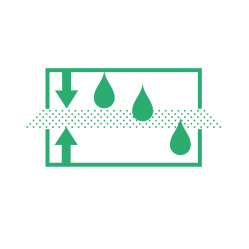
    Secutex® retains soil particles while allowing water to pass through freely.

  • Protection

    Protection

    Secutex® absorbs point loads and distributes pressure to protect adjacent geomembranes or sensitive layers.

Secutex® nonwoven geotextile advantages: high elongation, robustness and long-term filter stability

Secutex® nonwoven geotextiles combine mechanical robustness with stable hydraulic performance. The bonded fibre structure adapts to soil deformations. Separation and filtration functions are maintained throughout.

  • Adapte to subsoil

    Adapts to subsoil

    High elongation because of production technology. The nonwoven adapts to uneven ground, ruts and settlements. The separation function is maintained even under difficult subgrade conditions.

  • Easy installation

    Robust against installation damage

    High puncture force and dynamic perforation resistance. Withstands heavy compaction equipment and coarse fill placement. Reduces risk of damage-related filtration failure.

  • Function duration

    Long-term filter efficiency

    Filtration efficiency over the product service life. Prevents contact erosion and long-term soil particle migration.

Application areas

Typical applications:

  • Separation layer between subgrade and unbound base course
  • Filter layer under temporary construction roads and haul roads
  • Separation and filtration in railway subgrade
  • Filter and separation layer in earthworks and embankment fills

In road and railway construction, Secutex® acts as a combined filter and separation nonwoven. It sits between the subgrade and the granular base course. The nonwoven prevents upward fines migration into the base course and downward aggregate punching, so bearing capacity and filter stability are maintained over time. The GRK classification (GRK 3 to GRK 5) matches product robustness to installation conditions.

Advantages:

  • GRK 3 to GRK 5 grades cover light landscaping to heavy civil construction
  • High elongation prevents tearing under compaction equipment and heavy vehicles
  • Reduces required base course thickness – measurable material and cost savings
  • Stable hydraulic properties prevent pore pressure build-up under traffic loading
Roll of white geotextile nonwoven being unrolled on a construction site beneath heavy machinery

To the application:

Typical applications:

  • Protection layer for geomembranes in landfill base and capping systems
  • Cushioning layer between geomembrane and drainage gravel
  • Protection of geosynthetic barriers in tunnel waterproofing
  • Protection layer in groundwater protection and mining sealing systems

As a protection nonwoven, Secutex® cushions geomembranes (e.g. Carbofol®) and geosynthetic clay liners against mechanical damage. You install it directly on the geomembrane, below the drainage or cover layer. The thick needle-punched fibre structure absorbs point loads from coarse drainage gravel and prevents puncture during installation and over the long term.

Advantages:

  • High puncture resistance: 4,860 N (R 401) to 9,540 N (R 801) per EN ISO 12236
  • Protection grades up to 4,000 g/m² meet the 800 g/m² minimum for protection geotextiles
  • Protects geomembranes against gravel indentation during installation and over the service life
  • Chemically and biologically resistant as well as durable in landfill and groundwater environments

  • Earthworks and building over soft subsoils

    • Separation layer between soft subgrade and granular fill
    • Access roads and working platforms on low-bearing-capacity ground
    • Separation in embankments and reclamation fills
    • Separation beneath landscaping and recreational areas
  • Dyke and dam construction

    • Separation and filter layer in dyke body
    • Revetment filter below riprap

Technical properties

PropertyUnitR 401R 501R 601R 801R 1201R 2001
Product
Raw material—Polypropylene (virgin PP)Polypropylene (virgin PP)Polypropylene (virgin PP)Polypropylene (virgin PP)Polypropylene (virgin PP)Polypropylene (virgin PP)
Mass per unit area, nominal (minimum)g/m²400 (≥ 360)500 (≥ 450)600 (≥ 540)800 (≥ 720)1,200 (≥ 1,080)2,000 (≥ 1,800)
Thickness at 2 kPa, nominal (minimum)mm3.9 (≥ 3.5)4.3 (≥ 3.9)5.0 (≥ 4.5)5.3 (≥ 4.8)≥ 7.4≥ 9.9
Thickness at higher normal stressmm————≥ 4.0 at 200 kPa≥ 8.4 at 20 kPa
Mechanical properties
Max. tensile strength, md / cmdkN/m≥ 27.0 / ≥ 28.8≥ 31.5 / ≥ 34.3≥ 37.8 / ≥ 40.5≥ 46.8 / ≥ 50.4≥ 56.7 / ≥ 90.0≥ 76.5 / ≥ 144.0
Elongation at max. tensile strength, md / cmd%≥ 45 / ≥ 45≥ 45 / ≥ 45≥ 45 / ≥ 45≥ 54 / ≥ 40.5≥ 54 / ≥ 40.5≥ 54 / ≥ 36
Puncture force (CBR)N≥ 4,860≥ 6,030≥ 7,200≥ 9,540≥ 12,600≥ 18,900
Displacement at static puncture strengthmm≥ 45≥ 45≥ 45≥ 45≥ 45≥ 45
Dynamic perforation resistancemm≤ 8.4≤ 7.2≤ 6.0≤ 4.8——
Hydraulic properties
Characteristic opening size O₉₀ (± 30 %)µm80807070——
Water permeability normal to the plane, V(H50) index10⁻² m/s≥ 3.85≥ 3.15≥ 2.1≥ 1.75——
Flow rate (H50)l/(s·m²)≥ 38.5≥ 31.5≥ 21≥ 17.5——
Installation, certification and durability
Detector tested—————YesYes
Covering after installation—Within one monthWithin one monthWithin one monthWithin one monthWithin one monthWithin one month
Monitoring—Internal and external, DIN 18200Internal and external, DIN 18200Internal and external, DIN 18200Internal and external, DIN 18200Internal and external, DIN 18200Internal and external, DIN 18200
Management systems—EN ISO 9001:2015, EN ISO 14001:2015EN ISO 9001:2015, EN ISO 14001:2015EN ISO 9001:2015, EN ISO 14001:2015EN ISO 9001:2015, EN ISO 14001:2015EN ISO 9001:2015, EN ISO 14001:2015EN ISO 9001:2015, EN ISO 14001:2015
Further documents—CE marking, DoP, FPC certificate, product group EPDCE marking, DoP, FPC certificate, product group EPDCE marking, DoP, FPC certificate, product group EPDCE marking, DoP, FPC certificate, product group EPDCE marking, DoP, FPC certificate, product group EPDCE marking, DoP, FPC certificate, product group EPD
Durability (Annex B, EN 13249:2016), without reinforcement function, pH 4–9, < 25 °Cyears100100100100100100
Illustrative representation of the filtration mechanism in a needle-punched Secutex® nonwoven geotextile. The three-dimensional fibre structure retains soil particles while allowing water to pass through, illustrating the principle of long-term filtration performance.
Illustrative representation of the filtration principle of a needle-punched Secutex® nonwoven geotextile. The image visualises particle retention within the three-dimensional fibre structure while maintaining water permeability. It is intended to demonstrate the functional principle and is not a microscopic image of the actual product.

Opening size matters more than tensile strength in nonwoven design

Engineers specifying a nonwoven geotextile often check tensile strength first, but the decisive parameter is the characteristic opening size O90 — it determines whether the geotextile retains the correct particle fraction over the structure's service life.

O90 is the sieve opening below which 90 % of the geotextile pores lie, measured per EN ISO 12956. Secutex® R 401 and R 501 have an O90 of 80 µm, R 601 and R 801 of 70 µm — values that define compatibility with the adjacent soil grain curve. A wrong O90 causes clogging or piping, both leading to structural damage that no tensile strength reserve prevents. The FGSV and GDA guidelines therefore set O90 as the primary filter criterion; tensile strength is checked afterwards.

The second key parameter for separation geotextiles is elongation. Secutex® reaches 40 to 70 % elongation at break, so the nonwoven deforms around aggregates during compaction without rupture — where a woven product of identical tensile strength but low elongation fails.

For specifiers: match O90 to the d85 of the finer soil using the applicable filter ratio, then select the mass grade to meet the required GRK class.

Naue Portal - the free digital platform for geotechnical engineers.

Naue Portal: your all-in-one free geotechnical software solution for planning and cost estimation

  • One platform – multiple solutions: access a wide range of geotechnical design tools in a single portal.
  • User-friendly and accessible: available anytime, anywhere via desktop or mobile.
  • Optimised cost and material usage: reduce construction costs while ensuring long-term project stability.
  • Compliant with industry standards: aligns with AASHTO, and other engineering guidelines.

Frequently asked questions

Secutex® is a mechanically bonded nonwoven geotextile by Naue for separation, filtration and protection. You install it between soil layers of different grain sizes. The fibre structure prevents soil mixing, retains fine particles and absorbs point loads. It meets EN 13249:2016 and carries CE marking.

Secutex® pricing depends on grade, quantity, project location and logistics. Contact Naue via the button mentioned below for a project quotation. Pricing is always project-specific.

Secutex® is a nonwoven geotextile for separation, filtration and protection only. Combigrid® combines a geogrid with a Secutex® nonwoven for reinforcement plus separation in one product. Choose Combigrid® when subgrade reinforcement and separation are both required. Choose Secutex® alone when reinforcement is not needed.

O90 determines whether the geotextile retains the correct soil fraction over its service life. A wrong O90 causes clogging or piping regardless of tensile strength. For Secutex® R 401 and R 501, O90 equals 80 micrometres. Tensile strength becomes relevant only after the filter criterion is met.

Secutex® carries CE marking, Naue carries EN ISO 9001:2015, EN ISO 14001:2015 and EN ISO 50001:2018.

Secutex® achieves puncture force from 4,860 N (R 401) to 9,540 N (R 801) per EN ISO 12236. Elongation at break of 40 to 54 percent prevents tearing under compaction equipment. Select the GRK grade to match your installation conditions.

Secutex® complies with EN 13249:2016 (roads), EN 13250:2016 (railways) and EN 13251:2016 (earthworks). Also EN 13253:2016 (erosion), EN 13254:2016 (reservoirs) and EN 13256:2016 (tunnels). All properties are tested per corresponding EN ISO test standards.

Yes. Naue provides project-specific dimensioning support including filter criterion analysis and GRK grade selection. Use the Naue Platform for automated project calculations or contact Naue via the button below for direct engineering support.

Let’s discuss your project!

Please use the form to tell us about your enquiry
(* = required field)