Skip to content

Secutex® Soft Rock Geotextile sand container

Naue Secutex® Soft Rock is a geotextile sand container for coastal protection, scour protection and revetment systems along rivers.

  • Secutex® Soft Rock is a geotextile sand container (GSC) for coastal protection, scour protection and revetment systems along rivers.
  • The container is filled with locally available sand on-site. When installed as double layered system and the primary layer covers the gaps between the GSCs of the secondary layer, the GSC structure provides simultaneous filter and ballast functions. The nonwoven retains fine particles and absorbs wave energy without hard armour.
  • Variants: Secutex® Soft Rock R 601 (single-layer, unexposed) · Secutex® Soft Rock RS 801a (double-layer, unexposed) · Secutex® Soft Rock RS 1201 (double-layer, exposed) · Secutex® Soft Rock Grand RS 1201 (large-format, exposed) · Secutex® Soft Rock Grand RS 1601 (large-format, exposed) · Closing technology Smart available for Secutex® Soft Rock 601, Secutex® Soft Rock RS 801a, Secutex® Soft Rock RS 1201 with a fill volume of 1.0 m³ and 1.5 m³
  • BAW certified geotextiles (RPG:2021) · CE marking (EN 13249:2016) · EN ISO 9001:2015 · EN ISO 14001:2015 · DIN 18200 · EPD available

Secutex® Soft Rock is a geotextile sand container system for coastal protection, scour protection and revetment systems along rivers or coasts. Filled on site with locally available sand, the needle-punched nonwoven encases the fill material while providing both filter and ballast functions. Fine soil particles are retained, while wave and flow energy can be absorbed without the need for conventional armour stone in many applications.

Where water flow, waves or currents act on unprotected soil, fine particles can be mobilised and transported away. Over time, this may lead to surface erosion, scour formation, instability of banks, beds or structures, and progressive land loss. Conventional revetments made of armour stone combined with a geotextile filter are widely used to prevent this process. Secutex® Soft Rock provides an alternative revetment solution based on sand-filled geotextile containers. The containers help retain soil, stabilise the exposed surface and reduce hydraulic impact.

Secutex® Soft Rock containers are filled with locally available sand. This can reduce the demand for quarried rock, simplify logistics, support flexible installation in coastal, riverbank and scour protection applications and reduces CO2-emissions. In Scharbeutz, Germany, this avoided the extraction and delivery of approximately 60,000 tonnes of crushed rock. No concrete, no quarrying, no long-distance aggregate supply chain.

The GSC Secutex® Soft Rock RS 1201 (exposed application) delivers tensile strength of 60 kN/m (md/cmd) (EN ISO 10319), characteristic opening size O90 = 0.06 mm (EN ISO 12956), and seam strength of 50 kN/m (EN ISO 10321), with abrasion residual strength > 85% (rotating drum, BAW/RPG:2021). CE marking is per EN 13253:2016. Durability for a service life of 100 years (EN 13249:2016).

Secutex® Soft Rock functions:

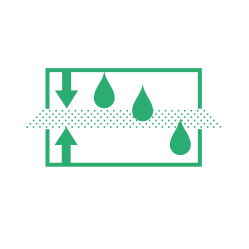
  • Filtration

    Filtration

    The permeable geotextile of Secutex® Soft Rock geotextile allows water to pass through while retaining soil particles, preventing washout and internal erosion.

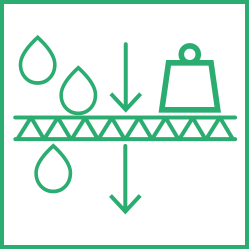
  • Separation

    Separation

    The geotextile creates a stable interface between the existing soil and the fill material of the geotextile sand containers, preventing the mixing of fine subgrade materials and fill.

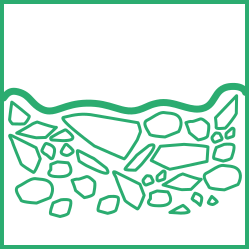
  • Packaging containment

    Containment

    Sand is securely contained within the high-strength geotextile shell, forming stable construction units that maintain their integrity under hydraulic loading.

Secutex® Soft Rock advantages

Secutex® Soft Rock is the smart alternative to conventional revetment systems. Geotextile sand containers combine filter and ballast function, when positioned in two lines in front of each other. They adapt to any subgrade, withstand dynamic wave loading and can be filled with locally available sand.

  • Easy installation

    Practical installation

    Containers are filled on-site with local sand so that no aggregate haulage is required. Containers can be placed from barges or cranes at depth for underwater installation.

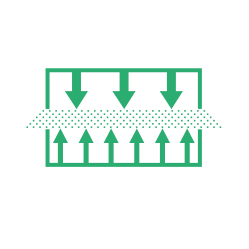
  • Filter and ballast in one

    Filter and ballast in one

    Two system components of a revetment system replaced by one, when installed as double layered system, so that the primary GSC layer covers the gaps between the GSCs of the secondary GSC layer: the nonwoven provides filter stability; the sand mass delivers its weight and positional stability.

  • Adapte to subsoil

    Adapts to uneven surfaces

    Soft, flexible construction elements conform precisely to irregular bed surfaces.

  • Function duration

    Long service life

    High robustness with residual seam strength > 85% after BAW abrasion test (rotating drum). The double-layer geotextile sand containers Secutex® Soft Rock RS 1201 or RS 1601 comes with a UV-resistant protection layer.

  • Certificate

    BAW certified

    The nonwoven geotextile meets BAW requirements for filter stability, abrasion resistance and puncture resistance (RPG:2021).

Application areas

Typical applications:

  • Dune reinforcement and geotextile walls in sensitive coastal environments
  • Beach erosion control, shoreline restoration, land reclamation and coastal protection
  • Wave energy dissipation and replacement of conventional armour stone revetments

At the German Scharbeutz beach, geotextile sand containers were installed in five layers in front of a flood protection wall, providing erosion and scour protection while replacing approximately 60,000 t of crushed rock. In other projects, stacked containers formed a geotextile wall to reinforce storm-damaged dunes and serve as a final barrier against breakthrough during storm surges.

Geotextile sand containers can also be used as the primary coastal protection measure within a beach nourishment and land reclamation scheme. The system helps restore a coastline that had retreated already, stabilised newly reclaimed land and creates the foundation for a major waterfront development.

Aerial view of a coastal protection project where Secutex® Soft Rock sand containers are installed at a beach.

To the application:

Typical applications:

  • Harbour bed scour remediation at harbour quay walls and bridge piers
  • Scour protection for offshore foundations (e.g.: for offshore wind farms)
  • Underwater installation without dewatering or divers
  • Riverbank erosion protection from barge installation

Secutex® Soft Rock R 601 is specified for protected/ covered hydraulic applications. In Southampton, UK, 1,160 containers were placed at 22 m depth at the Port of Southampton quay wall. No divers are required and port operations are not disrupted. For the Offshore Wind Park Amrumbank West a scour protection system with Secutex® Soft Rock has been installed for 80 wind turbines at water depths of -19 to -24m LAT .

Photo of a sand-filled geotextile Secutex® Soft Rock being installed on the water for scour protection.

To the application:

Technical properties

PropertyUnitSecutex® Soft Rock R 601Secutex® Soft Rock RS 801 aSecutex® Soft Rock RS 1201Secutex® Soft Rock Grand RS 1601
Product and application
Layer construction—Single-layer nonwovenDouble-layer nonwoven: filter layer and abrasion-resistant protection layerDouble-layer nonwoven: filter layer and abrasion-resistant protection layerDouble-layer, robust and abrasion-resistant staple-fibre nonwoven, homogeneously needle-punched
Raw material—Polypropylene (PP)Polypropylene (PP)UV-stabilised polypropylene (PP)UV-stabilised polypropylene (PP)
UV stabilisation—NoNoYesYes
Colour, filter layer / protection layer—WhiteWhite / beigeWhite / beigeWhite / beige
Nonwoven
Mass per unit area, total product (EN ISO 9864)g/m²600≥ 8001,2001,600
Mass per unit area, filter layer (Secutex® R 601)g/m²600≥ 540600approx. 1,000
Mass per unit area, protection layerg/m²—≥ 260600approx. 600
Thickness, nominal / minimum (EN ISO 9863-1)mm5.0 / ≥ 4.5——9.0
Max. tensile strength, md / cmd (EN ISO 10319)kN/m45 / 4550 / 5060.0 / 60.065 / 70
Elongation at max. tensile strength, md / cmd (EN ISO 10319)%60 / 6050 / 5060 / 60—
Static puncture resistance, CBR (EN ISO 12236)N8,0008,00010,50013,500
Displacement at puncture (EN ISO 12236)mm606060—
Dynamic perforation, cone drop test (EN ISO 13433)mm6.06.0——
Characteristic opening size O₉₀ (EN ISO 12956)mm0.080.080.07—
Apparent opening size AOS (ASTM D4751)µm———≤ 75
Water permeability VI(H50) index (EN ISO 11058)m/s3.5 x 10⁻²——1.0 x 10⁻²
Flow rate (H50) (EN ISO 11058)l/(s·m²)35252515 (at 100 mm head)
Water permeability, k value calculated acc. to TLG 2018m/s2.3 x 10⁻³——1.8 x 10⁻³
Resistance and durability
Hydraulic filtration efficiency (RPG and TLG 2018 of the BAW)—Soil types A and B———
Resistance to dynamic perforation by ripraps (RPG of the BAW)Nm1,800 – fulfilled———
Abrasion resistance, residual strength (RPG of the BAW, ISO 22182)%> 80> 80> 85> 85
Chemical resistance, residual strength (ASTM D 5322)%100100100100
Weathering resistance after 500 h – nonwoven / seam%———≥ 70 / 100
Friction angle in the shear plane, nonwoven vs nonwoven at 20/40/60 kPa (EN ISO 12957-1)°20———
Design lifetime, oxidation (ISO TS 13434)years100100100100
Container as delivered
Item number, EU product portfolio—832000832110 · 832100832300 · 832310 · 8323208304400
Colour, nonwoven outer / inner / yarn—White / white / blueBeige / white / blue——
Surface colour of the container as delivered—WhiteBeigeBeigeBeige
Tensile strength of the factory-made seam (EN ISO 10321)kN/m354050.040
Finished outer dimensions, empty, width x lengthm1.45 x 2.381.45 x 1.29 · 1.45 x 2.381.45 x 2.38 · 1.45 x 3.18 · 1.90 x 2.782.20 x 2.75
Dimensions when filled, width x length x heightmapprox. 1.25 x 2.05 x 0.44approx. 1.25 x 1.00 x 0.30 · 1.25 x 2.05 x 0.44approx. 1.25 x 2.05 x 0.44 · 1.25 x 2.74 x 0.50 · 1.63 x 2.40 x 0.55approx. 1.89 x 2.36 x 0.60
Theoretical fill volume at 90 % fill ratiom³approx. 1.0approx. 0.43 · approx. 1.0approx. 1.0 · 1.5 · 2.0approx. 2.5
Embedment length rectangular to the slope surfacemapprox. 2.05approx. 1.00 · approx. 2.05approx. 2.05 · 2.74 · 2.40approx. 1.89
Closing on site—Seam closure on site; Smart variant with factory-fitted tool-free closure availableSeam closure on site; Smart variant with factory-fitted tool-free closure availableSeam closure on site; Smart variant with factory-fitted tool-free closure availableFactory-fitted tool-free closing technique; filling via filling ports, cord closure on site
Split technical cross-section under identical wave action, comparing a conventional armour stone revetment with Naue Secutex® Soft Rock geotextile sand containers installed in staggered layers, with the lower containers enclosed by a nonwoven geotextile.
Exemplary illustration. Naue Secutex® Soft Rock combines filtration and ballast in a flexible construction element. The sand-filled containers adapt to the subsoil, distribute loads evenly and dissipate hydraulic forces while helping to prevent erosion of the underlying sediment.

Geotextile sand containers vs. armour stone revetment

Conventional revetments and geotextile sand containers (GSCs) differ fundamentally -— decisive in soft-bottom coastal and riverbank environments.

Conventional armour stone revetments

Two separate layers: a filter retaining fines while passing water, and rip-rap armour resisting hydraulic loads by self-weight and interlocking. The stone reflects wave energy into the substrate, progressively reducing subsoil shear stress and - with the armour's high density - risking differential settlement. A poorly graded or displaced filter additionally allows piping and progressive failure.

Secutex® Soft Rock GSCs

One element, both functions: a needle-punched nonwoven encapsulating local sand retains fines while staying permeable for pressure equalisation, and the sand fill provides ballast against waves and currents. Lower density and flexible geometry distribute pressure homogeneously, keeping subsoil shear stress stable, and the fill absorbs hydraulic energy instead of reflecting it. The roughened nonwoven surface gives markedly higher interface friction than woven containers.

Key parameters (RS 1201): seam tensile strength (CMD) 50 kN/m before and after abrasion (EN ISO 10321), abrasion residual strength > 85 % (rotating drum, BAW/TLG:2018), O90 = 0.06 mm (EN ISO 12956).

Naue Portal - the free digital platform for geotechnical engineers.

Naue Portal: your all-in-one free geotechnical software solution for planning and cost estimation

  • One platform – multiple solutions: access a wide range of geotechnical design tools in a single portal.
  • User-friendly and accessible: available anytime, anywhere via desktop or mobile.
  • Optimised cost and material usage: reduce construction costs while ensuring long-term project stability.
  • Compliant with industry standards: aligns with AASHTO, and other engineering guidelines.

Frequently asked questions

Secutex® Soft Rock is a geotextile sand container (GSC) system for coastal protection, scour protection and riverbank stabilisation. A needle-punched nonwoven geotextile shell is filled on-site with locally available sand. The nonwoven provides filtration (retains fines, passes water) and the sand fill provides ballast and shape stability. The combined element replaces, or complements, conventional armour stone revetments.

Pricing depends on project volume, variant (R 601 / RS 801a / RS 1201 / Grand RS 1201 / Grand RS 1601), closing technology (standard seam vs. Smart) and project location. Local sand fill significantly reduces material cost compared to quarried armour stone, as it avoids extraction and long-distance haulage. Request a project-specific quote via the contact form below or contact info@naue.com.

R 601 is a single-layer nonwoven (600 g/m²) for protected/covered applications where the container is not directly exposed to abrasive wave or current action. RS 801a and RS 1201 add a second, abrasion-resistant protection layer (200 g/m² and 600 g/m² respectively) for exposed applications. The Grand RS 1601 is a large-format, UV-stabilised double-layer variant (1,600 g/m² total) for the most demanding exposed conditions.

Smart Closing Technology is a factory-fitted, tool-free closing mechanism available for the R 601, RS 801a and RS 1201 variants, replacing the on-site seam closure. It speeds up filling and closing in the field. The Grand RS 1601 uses filling ports with a cord closure on site as its factory-fitted tool-free closing technique.

In coastal and riverbank applications, containers are subject to repeated wave action, sediment transport and surface abrasion. The BAW rotating drum abrasion test (RPG/TLG:2018) measures the residual strength of the nonwoven and seams after simulated abrasion. Secutex® Soft Rock RS 801a and RS 1201 achieve > 85 % residual strength; R 601 achieves > 80 %. Low residual strength would indicate progressive weakening and risk of container failure over the service life.

Secutex® Soft Rock is produced under EN ISO 9001 (quality management) and EN ISO 14001 (environmental management), with DIN 18200 factory production monitoring. The nonwoven meets BAW requirements for filter stability, abrasion and perforation resistance (RPG:2021 and TLG:2018). CE marking applies per EN 13249:2016 (RS 1201) / EN 13253:2016. Design lifetime of 100 years is declared per ISO TS 13434, provided the containers are covered within one month of installation.

Container size is calculated from the design hydraulic load (wave height, current velocity or ice load) using the Naue SoftRock design tool available in the Naue Portal, in conjunction with BAW MAK and EAK/EAU recommendations. Naue's Engineering & Design Department (EDD) can provide project-specific sizing and stability calculations.

Yes. At the Port of Southampton, 1,160 containers were placed at 22 m water depth without divers and without disrupting port operations. Underwater installation from barges or cranes is a standard method for scour protection applications such as quay walls, bridge piers and offshore wind turbine foundations.

Testing standards include EN ISO 10319 (tensile strength), EN ISO 9863-1 (thickness), EN ISO 9864 (mass per unit area), EN ISO 12236 (static puncture/CBR), EN ISO 13433 (dynamic perforation/cone drop), EN ISO 12956 (characteristic opening size O90), ASTM D4751 (apparent opening size), EN ISO 11058 (water permeability/flow rate), EN ISO 10321 (seam strength), EN ISO 12957-1 (friction angle), ASTM D5322 (chemical resistance), ISO 22182 (abrasion), and ISO TS 13434 (oxidation design lifetime).

At Scharbeutz, Germany, the installation of Secutex® Soft Rock sand containers in five layers avoided the extraction and delivery of approximately 60,000 tonnes of crushed rock, since the containers were filled with locally available sand instead.

Yes. Naue's Engineering & Design Department (EDD) provides project-specific stability calculations, durability assessments and specification support. The Naue Portal provides the “Naue SoftRock” design tool, free to use after registration, for stability calculations to BAW MAK and EAK/EAU recommendations. Contact info@naue.com or submit a project request via the contact form below.

Let’s discuss your project!

Please use the form to tell us about your enquiry
(* = required field)